Trade-off between the explainability and accuracy of AI systems
The EU ethics guidelines for trustworthy AI mention a trade-off between the explainability and the accuracy of AI systems.
Moreover, trade-offs might have to be made between enhancing a system's explainability (which may reduce its accuracy) or increasing its accuracy (at the cost of explainability). Whenever an AI system has a significant impact on people’s lives, it should be possible to demand a suitable explanation of the AI system’s decision-making process. Such explanation should be timely and adapted to the expertise of the stakeholder concerned (e.g. layperson, regulator or researcher). (p. 18)
In this case "accuracy" is mentioned, but it's better to speak in general terms of "performance".
This trade-off is also discussed and visualized in this blog post:
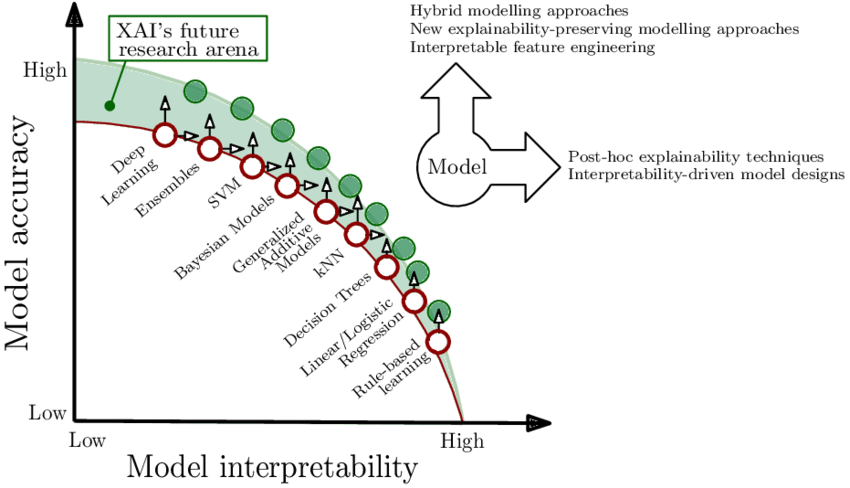
This trade-off really is difficult to navigate especially in critical applications, because in critical use cases for AI (e.g. where human lives are potentially directly affected) both the call for accuracy and for explainability is largest.
For state-of-the-art applications such as self-driving cars there is very little room for errors, requiring at least some form of machine learning or neural networks. Simultaneously, once a mistake occurs, the call for explainability is very high in order to trace back responsibility, liability and prevent future repetitions of the error.
"Explainable Artificial Intelligence (XAI): Concepts, taxonomies, opportunities and challenges toward responsible AI" by Barredo Arrieta et al. make the extra addendum that the trade-off between explainability and performance does not hold in general (p. 98-99).
Specifically, more complex models do not necessarily have more performance. In some cases, where we have good data and great features, simple models can have very good performance. In this case, we may use a simple model with high performance and high model interpretability! I.e. generally speaking we need more complex models only if the function to be approximated is more complex. In these situations, the trade-off appears.
Rudin (2019) even calls this perceived trade-off a harmful "myth" that discourages data scientists from even developing interpretable machine learning models. If you drop the (often unfounded) insistence on using black box algorithms and instead focus on building interpretable machine learning models using meaningful and sparse features, then interpretation can actually "reverse" the trade-off, because interpretation of iterative results can improve feature design, leading to better accuracy and better interpretability.