Lecture Notes Ethics for AI | Pim Haselager and Giulio Meccaci
Compile (from root directory of notes):
pandoc -s --toc AI/Master/E4AI-Lecture_Notes.md Zettelkasten/reasoning_fallacies.md Zettelkasten/Koepsell-Scientists_Moral_Responsibility_in_RnD.md Zettelkasten/Goldberg-Space_Shuttle_Tragedy_Ethics_of_Engineering.md Zettelkasten/neutrality_thesis_artefacts.md Philosophy/Van_Den_Hoven_2013_Value_Sensitive_Design.md Annotations/Ibo\ van\ de\ Poel\,\ Lambèr\ Royakkers\ -\ Ethics\,\ Technology\,\ and\ Engineering_\ An\ Introduction\ \ -Wiley-Blackwell\ \(2011\).epub.annot.md -o E4AI.pdf
Organisation
Reading materials:
- Ethics, Technology and Engineering. An Introduction. Ibo van de Poel and Lambèr Royakkers. (Abbreviation: ETE)
- A syllabus I overlooked until a day before the exam
- Human Compatible. Artificial Intelligence and the Problem of Control - Stuart Russell
Schedule
- Introduction
- Ethics 101 (ETE Ch.3)
- From theory to practice (ETE Ch.4)
- Technology and Responsibility (ETE Ch.1&9)
Related notes/readings:
- E4AI Questions
- Reasoning fallacies
- David Koepsell on "On Genies and Bottles: Scientists’ Moral Responsibility and Dangerous Technology R&D"
- Boisjoly et al. - "Roger Boisjoly and the Challenger Disaster: The Ethical Dimensions"
- Goldberg - The Space Shuttle Tragedy and The Ethics of Engineering
- Neutrality Thesis
- In favor: notes from Vermaas et al.
- Against: notes from Pitt - on "Guns don't kill people, people kill people"
- Van den Hoven - Responsible Innovation and Value-Sensitive Design
1. Introduction
Q: Why are ethical skills important for people working in AI?
- AI is prominent in daily life so we need to consider its implications
- Society demands ethical reflection on the consequences of technology
- Funding agencies require ethical "pillars"
Science & Policymakers
Relating to the last point: the idealized "scientific research cycle" is only one part of a larger cycle where you try to find funding for your research ideas. Within this larger cycle, there is also interaction with policy makers. Whether you may get money for research may depend on its ability to be translated into useful policy for certain groups, that may also provide funding.
This adds another dimension to doing research because policymakers usually have the general public in mind.
The media play a role in the translation of science between scientist, policymakers and the general public.
At the same time, policymakers e.g. politicians often (mis)use science opportunistically to support a position they already held independent of that science.
The ethical cycle
See the "cheat sheet" and chapter 5 of ETE.
Assume you are provided with a case.
- Problem statement: Is there an ethical problem?
- What is the problem
- Who has to act? (Maybe irrelevant in case of a general question)
- What is the moral nature of the problem?
- (General tip: if possible, frame the problem such that is does not already presuppose too much (e.g. a black-and-white strategy) )
- Problem analysis: What is at stake?
- Who are the stakeholders?
- What are relevant moral values?
- What facts are relevant, uncertain or potentially missing/overlooked?
- Options for action
- Black-and-white (do this action, yes or no?) vs grey or creative "middle way" solutions
- Cooperation strategy: consult stakeholders to find alternative actions that may be a win-win (nobody is worse off, at least)
- Whistle blowing
- Ethical evaluation: output, a moral judgment/evaluation with arguments (not yet a decision!)
- Formal: a. Consider the main ethical frameworks b. Codes of conduct
- Informal
- Intuitivist framework: choose an action based on moral intuition and find arguments for it
- Common sense method: think about what the relevant values are; in particular what the guiding dominant value is (usually an intrinsic and not an instrumental value)
- Reflection: are we sure about moral judgment X?
- Is it supported by ethical frameworks and, if not, does the specific situation override the general ethical theory?
- Does an ethical framework help you distinguish the morally relevant facts?
- Engage in criticism of the ethical theories rather than taking them for granted
- Desired result: wide reflective equilibrium between these considerations. See below.
- Main point: "by trying to achieve a wide reflective equilibrium you are forced to engage in a broader and more systematic theoretical consideration of the case, including a range of arguments and reasons. It is precisely because this reflection involves theories, that such reflection becomes broader and more encompassing."
- So should be based on collective moral deliberation.
Wide reflective equilibrium aims at making coherent three types of moral beliefs:
1) the moral judgments that were considered 2) Moral principles 3) Background theories * Including other theories (also psychological and sociological theories) is important to not just cherry pick principles that fit our judgments. * These background theories moreover connect to other cases (in which those background theories are relevant); thus connecting with prior cases. * Taking into account different perspectives makes it more likely all relevant aspects have been considered
ETE cites Daniels (1979) but I found Rawls first (https://plato.stanford.edu/entries/reflective-equilibrium/).
- What defines the "wide" equilibrium for Rawls is precisely that you also take into account alternative moral perspectives rather than finding equilibrium within the constraints of one (or few).
- Equilibrium does not necessarily presuppose full agreement between different stakeholders, but can be a case of overlapping consensus between the reflective equilibria of others.
- Not the same as a compromise
- Overlapping consensus is a situation where parties agree on a moral judgment (aspect 1) even though they may reach that judgment based on different moral principles (2) and background theories (3). (Interpretation in ETE)
- Raws: Overlapping consensus is more likely when participants focus on "public reasons" i.e. reasons we think apply for everyone.
Van de Poel and Zwart (2010) additionally argue that social arrangements can facilitate overlapping consensus
- Learning is important because it may lead stakeholders to change their position, so that overlapping consensus may become achievable
- Inclusiveness (all relevant perspectives are taken into account) and openness (new considerations and parties are welcome) are important because otherwise consensus is only achieved by leaving out potentially important perspectives.
- Both Rawls and Habermas also focus on these procedural methods for establishing moral consensus and whether it is sound.
- Compare CTA (Constructive Technology Assessment) and social ethics.
Follow-ups on reflection:
- What if the ethical theories are not applicable?
- Note that the ethical frameworks are here used for reflection i.e. justification rather than prescribing action.
2. Ethics 101
Descriptive vs normative
Descriptive:
- Describing a state of affairs
- Has truth value that can be ascertained (in principle) by looking at the world
Normative:
- Judgment about whether something is good or bad etc.
- Agree or disagree
Cases where you may argue for both sides:
- "This switch is safe"
- According to which regulations? That would be a factual reference
- Or are you saying this from your own personal judgment and norms about safety?
- "I don't like this switch"
- This is a preference, but the norm is unclear.
- This is why these types of utterances cannot be the basis of ethical discourse.
- This can be seen as describing a preference, that is in theory observable for others by your behavior towards the switch.
Ethics and morality
N.B. both these terms have the same linguistic roots, but over time a semantic distinction has emerged.
- Ethics: the systematic reflection on what is moral
- Morality: totality of opinions, decisions, actions with which people express, individually or collectively, what they think is good or right.
Main concepts of ethics
What underlies ethical discussion?
- Ethical discussion has to be based on reference points (e.g. norms) and criteria that enable dialogue.
- Not just "I don't like this"
- Even though ethical discourse may of course start with a moral intuition
Values
- Values: lasting convictions that people feel should be strived for in general, i.e. it is not just a personal preference but is generally held to contribute either to a good life or a better society.
So:
- Something to strive for i.e. a goal / end
- Values are also not preferences/interests, but pertain to more globally held convictions about what is desirable
- Further distinction between intrinsic and instrumental values.
Q: is privacy an intrinsic or instrumental value?
Norms
- Norms: rules that prescribe what actions are required, permitted, or forbidden
- They codify values
- So where values are ends, norms are means for achieving values.
- That also means they relate values to specific contexts.
Virtues
- Virtues: human characteristics or qualities deemed desirable
- Moral virtues: character traits that make someone a good person / allow people to live good lives.
Values vs norms, values vs virtues
There is thus a bidirectional connection between values and norms:
- Values are hard to achieve without connected norms that prescribe how to achieve them
- Norms without values are ineffective and meaningless
Q: What would be a norm without a connected value?
"By being in this room, you are required to fold paperclips during programming"
Q: What is the relation and/or difference between values and norms?
Values are aspirational and to be strived for, but are not directly connected with specific rules that specify how to achieve a particular value. In practice, values and norms should go hand in hand. Norms are only meaningful in light of the aspirational values they support, whereas these values are ineffective without any way I do think that in practice people immediately do think of connected norms when thinking about a value.
Q: What is the difference between virtues and values?
As said above, values are ends that are strived for on a supra-individual level. But this also means that they are not necessarily lived in a particular individual. This is the main difference with virtues, which is a personal characteristic that supports moral values and collective well being.
So values are defined on a broader cultural level but are not necessarily lived on the individual level, i.e. they are not by themselves already virtues. Virtues do however necessarily embody values: they are innately good qualities and are valued as such.
What virtues support a given value?
Example:
- Value: Integrity
- Virtue (one of many): honesty (solidified in individual character)
- Norm (one of many): do not lie to your parents (rule that support the aspirational value of integrity and the lived value i.e. virtue of honesty.
Relativism vs absolutism and universalism
Strands of relativism:
- Very strong: all values, norms and virtues are equally valid
- Weaker: there are no universal (or absolute) norms
Problems with relativism:
- What happens when you find another culture in which killing others for petty reasons is normal and accepted. Can you really maintain that their values, norms and virtues are equally valid? (Strong relativism, obviously)
- Or "Torturing people for fun is wrong"
- You may point out universal moral values: e.g. the moral value of preserving human life.
- "All values, norms and virtues are equally valid" is itself a normative statements and is thus self-contradictory.
- Relativist may point out there is little or no agreement about moral issues across the globe. But this is a non-sequitur. Disagreement about moral truths does not imply the absence of moral truths / the fact of the matter at stake.
Universalism: there is a universally applicable system of norms and values.
Absolutism: all actions are intrinsically right or wrong. An absolutist would for example state that stealing is inherently wrong, even if this is done with morally good intentions (e.g. stealing to feed your dying child in a situation of immense duress).
N.B. so universalism is not necessarily absolutist.
Q: What is an example of a universally applicable ethical theory that is not absolutist?
Well, utilitarianism is a great example here. It is a system that is applicable to all moral considerations, but it does not commit to one particular set of values or norms. It merely requires you to weigh them against each other by the maxim that the utility after the moral decision should be maximized, given the situation.
Ethical theories
- Does not imply knowing what is right or wrong
- Helps understand moral intuitions
- And elucidate the principles underlying them
- Identify limits to our views
- Important for becoming a responsible professional
Ethical theories are primarily ways to answer the question "why is this right or wrong or fair etc." and are thus ways to justify action.
They only in some cases clearly recommend actions.
This point is not entirely clear to me, because when reflecting on what action to take, you may consider ethical theories to ask "how would this action be justified". This in turn may be an argument for acting in a particular way.
Maybe the point mainly is that these theories rather focus on norms or values, which do not always directly translate to actions. Also, in case of consequentialist reasoning, there is uncertainty about outcomes.
Q: Can you name an example of an ethical theory that does make recommendations?
I would say this is deontological ethics: it is heavily prescriptive and also disregards the consequences of actions and the uncertainty that they introduce.
Consequentalist
- Action's "goodness" measured according to consequences
- Actions are morally justified insofar as they promote values (and how much)
- E.g. does an action promote safety, or privacy?
Utilitarianism
Basic form by Jeremy Bentham.
Most well-known variant is utilitarianism: actions are judged by the amount of pleasure and pain they bring about, specifically whether they maximize happiness for the greatest amount of people.
Q: Which value does utilitarianism focus on?
Greatest common good / utility principle.
Q: What's a limitation of this "moral balance sheet"?
Actions leading to the greatest common good are not necessarily acceptable, or the most ethical. (E.g. organ harvesting a healthy person to save four patients in need of an organ transplant).
Such weir situations may be avoided with a variant by John Stuart Mill introduces quality into the equation: "it is better to be a human dissatisfied than a pig satisfied; better to be Socrates dissatisfied than a fool satisfied".
Adds a freedom / no harm principle: one is free to strive for pleasure insofar as this does not hinder the pleasure of others (cf. for example by harvesting their organs).
Modern version: increase average utility in society rather than maximizing greatest utility for the greatest amount.
The Ford Pinto case is a good example of utilitarianism / technoethics gone wrong. Calculate: what's the worth of a human life? There is a difference in valuing human life and monetarily evaluating human life.
Summary issues:
- consequences are unforeseeable
- Rawls: justice cannot be accounted for by a value; theory does not sufficiently distinguish between persons?
- Very small role for care and affection
- They ends do not always justify the means; some means may have intrinsic (bad) moral value
- A "dictatorship of the majority" is not ethical.
Deontological / duty ethics
- Actions are evaluated in themselves (vague formulation; I would say they are actually measured by a norm)
- Actions are justifiable if they follow a certain norm/principle/law, even though the consequences may be undesirable.
Kant's categorical imperative is a universal principle from which all other moral norms can be derived.
Two main formulations:
- Universality principle: act only on such a maxim of which you can at the same time will that it should be come an universal law (without ending up in a contradiction with your own actions).
Example: if you break a promise, and infer from this the maxim "promises can be broken" and then extend this into a universal law "everbody can break their promises", is this then what you think is good?
- Reciprocity principle: act so as to treat humanity (so irregardless whether it concerns you yourself or an other) always as an end in itself and not as a means.
Norms and rights
Deontological ethics is a natural fit with discourse on fundamental (human) rights, such as:
- Dignity
- Freedoms
- Equality
- Solidarity
- Justice
Issues
- It is possible to derive conflicting norms from the categorical imperative
- You must absolutely try to save a life when possible
- You should not lie
- This is a clear conflict in any situation where you may have to lie in order to protect someone
- Negative consequences can be overlooked
- Child labor is an interesting case. In deontology child labor is intrinsically morally wrong and detestable.
- However, this does not factor in a possible argument from the utilitarian side that in some situations child labour may be the only option to have enough income to feed a family.
- I.e. deontology is not sensitive to action consequences that may in principle be relevant to consider.
Virtue ethics
- Action is evaluated according to the actor
- What good or desirable characteristics must one develop to be called moral?
- A happy life realized full human potential through virtuous living
- Virtues are equilibria between two extremes; wisdom is for finding the right middle ground.
- Action is justifiable if they correspond to how a virtuous person would act
- Big part to play for role models
Thomas Aquino:
Cardinal virtues:
- Prudence
- Temperance
- Justice
- Fortitude
Theological virtues:
- Faith
- Hope
- Charity
Issues
- How do you measure virtues? By behavior, in principle. But this does not exclude bad intentions.
- I'm thinking of this Plato dialogue where Socrates asks whether it is better to seem virtuous/just while not being it, or to be virtuous/just while not seeming to be it.
Virtues of AI professionals
Minimal:
- Reliability
- Honesty
- Responsibility
- Solidarity
Specifically for engineers, by Pritchard (2001), ETE 113:
Pritchard 2001:
- Expertise/professionalism
- Informative communication
- Cooperation
- Willingness to make compromises
- Objectivity
- Being open to criticism
- Stamina
- Creativity
- Striving for quality
- Having an eye for detail
- Habit of reporting work carefully
3. Reasoning from theory to practice
Corresponding reading: ETE Ch. 4.
Main questions:
- What is it like to have a technoethical discussion
- What are sound and what are valid arguments
- What are the common reasoning schemes?
- What are the common reasoning fallacies?
Slides discuss possible arguments around providing safety nets on the Golden Gate bridge, because it is frequently used for suicides.
Types of reasoning
Deductive:
- Conclusion is strictly implied by the premises
- Its validity does not depend on the truth of the propositions
- Monotonic: adding premises cannot change anything in the logical validity of a conclusion
- In classical logic, not even a contradiction due to the conclusion then being a vacuous truth.
Non-deductive:
- premises give partial support
-
Non-monotonic: adding a premise might change the conclusion
-
Everytime I dive in water, I make a splash
- I'll dive in water
- So I'll splash
But this reasoning changes when you add a third premise that it is extremely cold and that thus the water is frozen.
Example of a non-inductive scheme:
- Argumentation by analogy (with a more clear and well-known case)
- The quality of the argument depends on the quality of the analogy
- For determining the quality of the analogy, you should asks what the relevant aspects are that should be similar
- Criteria:
- Stronger when there are more similarities between two domains
- More differences between two examples (not necessarily domains) weaken the analogy
- More ignorance about the two domains weakens the analogy
- Stronger when the similarities are relevant
Common fallacies in ethical and technical debates
- Ad hominem: attacking the author instead of the argument
- Naturalistic fallacy (ought-is)
- Something should be because currently it is that way
- Wrong transition from descriptive statements to normative statements
- "There has been war since the dawn of humanity, so it can't be morally wrong"
- Straw man: attacking a (weaker) misrepresentation of the opponent's argument
Sven Ove Hanson identifies specific fallacies of risk in technological discussions:
- Sheer size fallacy:
- X is accepted
- Y is a smaller risk than X
- So Y should also be accepted
I think this fallacy may apply to self-driving cars: We should accept self-driving cars because currently driving is already killing a lot of people and self-driving cars are likely to decrease that number. This reasoning is only valid when human driving and AI driving are comparable enough (it may be, though).
-
Ostrich fallacy
- There is no scientific proof that X is dangerous
- So X does not give an unacceptable risk
- (The correct conclusion would be: we do not know and perhaps: better safe than sorry)
-
Delay fallacy
- We take no decision about X now because we first need more data to understand the problem
- This fallacy is interesting to counter with the paradigm of value-sensitive design
-
Price fallacy
- We must weight benefits and risk of X
- So X is something we have to put a price on
- E.g. it is most likely not ethical to put a price on a life
Copied to here .
4. Technology and Responsibility
Corresponding reading: ETE Ch. 1&9.
Main questions:
- Is technology morally loaded, or is it the way we use it?
- What are my moral duties as a person and as a professional?
- What are my responsibilities, and how do I act responsibly?
- How do I manage my relationship with my employer?
- How do we assess personal and collective Responsibility?
Is technology morally neutral?
Neutrality thesis: technology itself is neutral, but its use is not.
Non-neutrality thesis: a technical artefact is a morally loaded instrument
Example conversation:
- Alice: Technology has a use plan
- Bob: But technologists cannot determine and foresee its use
- Alice: Inventions bring about new possible and morally relevant actions
- Bob: But users still decide what to do with these possibilities
Professional responsibility
Professional responsibility comes with what is expected of your professional role.
That role may be supported or clash with your personal moral responsibilities.
Q: What are your responsibilities as AI professionals?
Passive responsibility
Passive: after the fact, backward looking
- Accountability: provide an account of what has happened and why if you were responsible
- Blameworthiness: this could make you the object of moral blame, in case of:
- Wrongdoing; breaking a moral norm or code of conduct
- Causal contribution; either by doing or refraining from doing
- Foreseeability; you can't be held accountable for consequences that were impossible to foresee
- Freedom of action; no coercion of extreme duress
Active responsibility
Active: forward looking, taking into account both moral and professional duties
Active responsibility is therefore never really fulfilled. It is primarily about aspiring to reach an ideal.
Ideals can differ of course.
- Technological enthusiasm: go ahead and do it for the sake of technological innovation itself . E.g. Oppenheimer.
- Worry about consequences later?
- Effectiveness and efficiency, e.g. Frederick Winslow Taylor.
- Worker exploitation?
- Human welfare, e.g. "Engineers against poverty"
What's the role of engineers and managers?
Should technologists be realist and pragmatic, or more idealist?
- Separatism
- Engineer as "hired gun" that only cares about getting the (technical) job done and not about the social consequences
- Technocracy / social engineering
- Whistle-blowing
Whistleblowing guidelines for engineers:
- Establish a clear technical foundation
- Keep your argument on a high professional plane, avoiding emotions and extraneous issues
- Catch problems early, and discuss them with the lowest possible managerial level
- Before going out, make sure the issue is sufficiently important
- Use established organizational dispute resolution mechanisms
- Keep records and collect papers
- Resign
Societal context
Stakeholders: actors who are affected by technological development (irregardless of whether they themselves have a causal influence on the process)
Relatively straightforward examples:
- Regulators
- Companies
- Designers
- Embedding values and moral considerations into technology
- Conscious and explicit thinking about values embedded in technology is morally significant
- Articulate moral considerations early to avoid wasting resources
- Involve stakeholders
5. AI and Ethics
Normative ethics overview
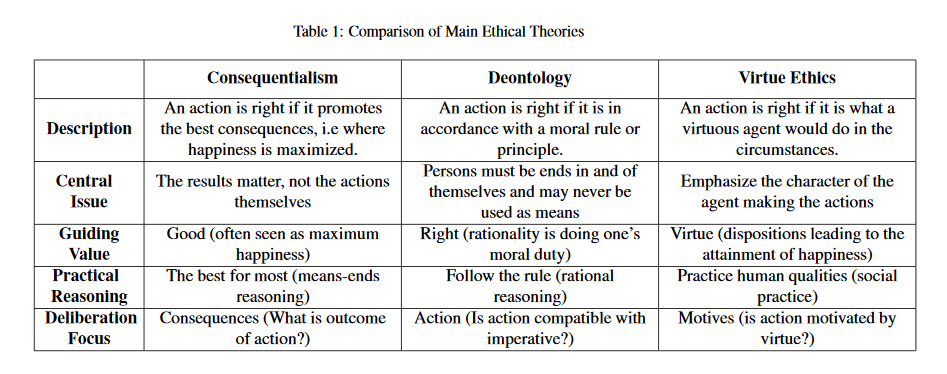
Reproduced from Virginia Dignum - Responsible Autonomy
Another important distinction is between normative and descriptive ethics.
Descriptive ethics
Empirically studies moral psychology and also its evolutionary, neuroscientific and sociological aspects. How do humans, in practice, act, think, feel and also communicate morally?
From this perspective, one may point out that:
- Moral thinking is good for social doing and reputation preservation, because you are good at explaining why you did what you did
- Humans are quite good politicians: trying hard to look good, more than being good
Jonathan Haidt in "The Emotional Dog and Its Rational Tail", Psychological Review 2001 Volume 108 (4) , pp. 691-869.
“If moral reasoning is generally a post hoc construction intended to justify automatic moral intuitions, then our moral life is plagued by two illusions” (p.823)
- Wag the dog illusion
- We believe that our own moral judgments (the dog) are driven by our moral reasoning (the tail)
- Was the other dog's tail illusion
- We believe that successful rebuttal of someone else's arguments will actually change their mind.
Haidt's six moral "taste buds"
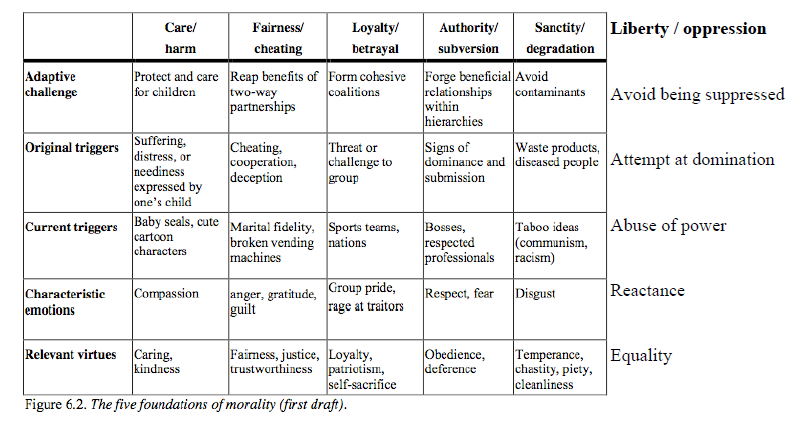
Based on these moral taste buds, you can construct different "moral matrices" for people of different orientations.
E.g. a liberal will probably have a very strong "care-harm" and "liberty-opppression" tastebud and very little e.g. for "authority-subversion", whereas a social conservative will likely have a quite uniform distribution over the tastebuds (being mainly concerned with preserving of institutions / keeping things in balance).
Example stakeholder categories
Example stakeholder categories in healthcare:
- Organisations and institutions
- Government (local and national)
- Industry representatives
- Health care providers
- Other individuals
Case study of care-giving (AI) robots, using the ethical cycle
N.B. what's quite annoying is that Haselager cites the "ethical cycle" constantly, which starts with 1. Problem statement and 2. Problem analysis, but calls 1) "Anaysis" instead and 2) "What is at stake?"
Also, I do not understand how the matrix of slide 16 works, because it does not seem possible to fill in all fields of the matrix.
- Problem statement (sketch)
Explorative questions:
What are the main possibilities, concerns/fears, values/norms/virtues, who are the main stakeholders? Who are participants in HRI?
Possibilities:
- Help with simple practical tasks
- Impersonal support for privacy sensitive situations (a.k.a. taking a huge dump)
- Regularity (e.g. reminder for taking medicine)
- Interactive company
- Replace human workers (economic benefits)
Concerns:
- Social isolation (even less human contact)
- Autonomy
- Human dignity (humiliation, objectification)
- Privacy (do robots interfere with the right to be left alone?)
Values:
- Health
- Equality
- Happiness
Who are the stakeholders?
In the case of care-giving robots:
Directly:
- Producers
- Programmers
- Owners
- Instructors
- Collaborators
- End-users i.e. patients
- Visitors
- Relatives
Indirectly:
- Insurance companies
- Health-care institutions
- Hospital boards
- Health professional associations
- Patient organizations
Each stakeholders has particular interests, responsibilities, and potential liabilities.
Participants: adults, elderly, children, patients, other help animals, robots
Assignment:
Understaffed elderly facility contemplates buying ICT/AI equipment. You have an introductory meeting (30 minutes) with the board members,
1) What are the questions you prepare for them? 2) Specify what kind(s) of conclusions or recommendations you are taking into consideration while asking these questions, e.g. a) What kinds of goals/tasks would you like to apply the ICT/AI to? b) What kinds of ethical aims/goals/concerns/aspects can you specify that need to be addressed?