Virtual Worlds and their Challenge to Philosophy: Understanding the “Intravirtual” and the “Extravirtual” | Johnny Hartz Soraker, Metaphilosophy (Philoweb special), Vol. 42, No. 4, 2012.
Abstract
Real-time interactions in 3D virtual environments challenge traditional frameworks. Also that of Verbeek!
The present article illustrates this by arguing that the notion of “technology relations,” as put forward by Ihde and Verbeek, becomes inapplicable when it comes to the Internet, and this inapplicability shows why these phenomena require new philosophical frameworks. (499)
New distinction: intra- and extravirtual:
Against this background, and more constructively, the article proposes a fundamental distinction between “intravirtual” and “extravirtual” consequences—a distinction that allows us to understand and conceptualize real-time interactions online more accurately.
See Floridi 2005. “The Ontological Interpretation of Informational Privacy.” Ethics and Information Technology 7, no. 4:185–200.
Introduction
Challenges of the internet.
- Created "myriad conceptual muddles" for most concepts of the history of philosophy (499), see Moor 1985
- And re-ontologization (Floridi 2005) of the world "towards increasingly digital, as opposed to analogue, entities, events, and experiences."
Challenges to basic concepts (directly cited, but I introduced the enumeration):
- the notion of “space” is challenged by the way in which the Web creates new spaces for actions and events to unfold, (499)
- the notion of “time” is challenged by its increasing disentanglement from physical distance, (499)
- the notion of agency is challenged by “bots” and other artificial agents, (499)
- and the notion of mind itself is challenged by the way in which many cognitive functions such as memory become causally intertwined with (and increasingly dependent on) instantly available information online (Clark and Chalmers 1998). (500)
Many other technologies changed the agenda of philosophers as well (e.g. the telescope and the pre-Web computer). Two complementary and influential frameworks:
In an attempt to understand how technology can change our relation to the world, numerous philosophers have also tried to develop new theoretical frameworks Two complementary and influential frameworks have been developed by postphenomenologists Don Ihde (1990) and Peter-Paul Verbeek (2005), and their approaches try to shed light on different ways in which technology changes the relationship between the subject and its lifeworld. (500)
Main claim: these are not capable of dealing with the impacts of the Internet!
In this article, I argue that these frameworks are incapable of dealing with the radical yet subtle way in which the Internet changes our relation to the world and others, and through this analysis attempt to show both the uniqueness of the Internet as a technology and the challenge it poses to some of our most fundamental philosophical notions. (500)
Importance of the new distinction:
Furthermore, I introduce an important distinction between what I refer to as “extravirtual” and “intravirtual,” which allows us to better conceptualize actions and events that are made possible by the Internet, and which also sheds light on why it is (or should be) so difficult to arrive at an observerindependent ethics for online behaviour. (500)
Because the web is so broad this article focuses on virtual worlds.
Def: By “virtual world” I refer to computer-simulated, interactive, multi-user, threedimensional environments, where users can interact with each other by means of graphical representations of themselves (“avatars”). (500)
The Web3D consortium concerns standards and protocols for integrating that type of application into the Web.
The fact that current philosophy on technology relations is inapplicable says something about the unique characteristics of the internet (cf. 501).
Post-phenomenology and Technology Relations
- The four relations by Ihde
- Verbeek's extension (e.g. Verbeek 2008, 391):
- Cyborg relation, deeper than embodiment (Verbeek calls it "immersion" in Verbeek-Designing_Public_Sphere_Politics_of_Mediation.md .
- Composite, "in which technologies not only represent a phenomenon in the world but construct reality instead" (502)
Explanation of the composite relation:
For instance, a radio telescope generates an image comprehensible by humans on the basis of detecting radiation that is invisible to the eye. This is not merely a form of bringing what is far away closer or enlarging microscopic entities; these technologies construct that which cannot be perceived by humans—and sometimes generate a representation in an entirely different modality as well, for instance by making sounds visible. (502)
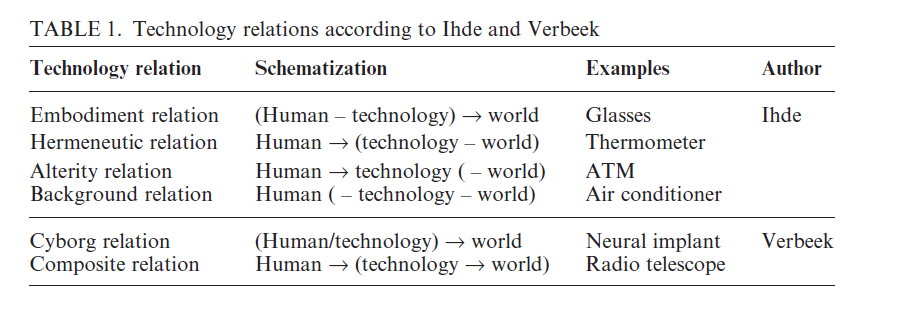
Are these relations sufficient for explaining how the Web changes "the relationship between subjects, and between subjects and reality?" (502)
Applying Technology Relations to Virtual Worlds
Technological mediation concerns human-tech-world relations.
But if we take the "re-ontologisation" of Floridi etc. seriously, then the world is already technological. (my additional remark) This is especially the case if we seriously consider the idea of virtual worlds.
The first expected counter is to restrict the concept of "world" to the physical world. Issues:
- If we use tech to access virtual worlds, are these technologies part of the mediation between human and virtual world?
- How to conceptualize technologies within the virtual world?
- Can Ihde's relations be applied to virtual entities within the virtual world? E.g. virtual meters?
- "Are these entities part of the virtual-world-as-technology, or are they themselves technologies within another technology?" (503)
- Standpoint of author: "It could be argued that we do not directly interact with these technologies, but reducing a virtual world to our interaction with the computer and peripherals hardly makes sense."
Very interesting point for me! The virtual world is itself a form of hermeneutic technology.
To make matters even worse, the virtual world can be seen as a form of hermeneutic technology as well, because it does mediate the physical world—in particular, the actions of other human beings. (503)
Main complications of virtual worlds as hermeneutic technology:
- With virtual worlds (i.e., when there is an online multiplayer element), the world is no longer bracketed because we communicate with actual human beings through the virtual world/technology. (503)
- This, in turn, is seamlessly combined with all kinds of non-human “alters” within the virtual world.(503)
- Finally, as if the notions of “technology” and “world” are not difficult enough to place in these relations, the concept of “human” is also complicated by the fact that the interactions are carried out as if done by a representation of the human (an “avatar”), and done from the standpoint of that avatar’s indexical location within the world/technology. (503-504)
All conceptual difficulties in summary:
In short, with virtual worlds the relata in the technology relations of Ihde and Verbeek become ambiguous. “Human” may refer to the actual human or to the avatar representation. “Technology” may refer to the user’s computer and peripherals, the computer simulation and databases that underpin the virtual worlds, the virtual world itself (as experienced), and/or virtual entities within virtual worlds. Finally, “world” can refer to the actual or the virtual world. (504)
What interests me mostly is all the ambiguities of the technology pole, in particular whether the interaction is at bottom an interaction with 0s and 1s. Or is the focus on experience?
Verbeek's candidate is the composite relation, i.e. the idea that virtual worlds are technologies that construct reality.
At least partly correct: the virtual world mediates "computer states (encoded strings of binary digits) as unobservable aspects of the physical world." (504)
I think this point kind of extends to all ICTs: they support information flows between humans, between humans and systems, and between systems themselves, by mediating the binary digits that at bottom make up each ICT application.
This idea however falls short, because it skips the element of experiencing the immersion of a virtual world and interaction with others in it:
this fails to capture the relation between two humans interacting with each other through a virtual world. Although it may be technically correct to describe virtual worlds as constructing that which cannot be experienced as such (i.e., the underlying computer states), this misses the experience of being immersed in a virtual world and of communicating with another human being by way of avatars—and losing the subjective experience seems particularly unfortunate from a (post-)phenomenological point of view. (504)
There is thus a deep ambivalence in the concept of virtual worlds that is not captured solely by Verbeek's technological relation:
Virtual worlds are both worlds and technologies, the computer simulation is both the underpinning of the virtual world and the means of mediation, entities within virtual worlds can be regarded as technologies themselves, and although virtual worlds mediate the physical world and other human beings, they also construct reality. (504)
Extravirtual and Intravirtual Consequences
When virtual worlds are not being taken seriously this is usually based on the idea that they are imaginary and have no effect in the physical world (and consequently, that there can be no physical harm resulting from online communication) (cf. 504).
But this overlooks "that any change in the virtual world necessarily corresponds to changes in physical reality—that is, changes in the physical computer running the simulation." (505)
Imagine that a particular computer state triggers detonation of a bomb.
What happens is that the virtual event has two very different kinds of effects, what I refer to as intravirtual and extravirtual effects. By moving my physical body (extravirtual) in such a way that I throw a virtual rock (intravirtual), I am causing a change in the state of the computer running the simulation (extravirtual). This change of state, in turn, can further produce both intravirtual and extravirtual effects—respectively, the breaking of the virtual window (intravirtual) and the detonation of the bomb (extravirtual). (505)
Main implication:
The important point here is that although the virtual world as such is observer dependent, the computer states that underpin the virtual world and give rise to having a shared experience are themselves observer independent. (505)
Intravirtual Versus Extravirtual Conditions of Satisfaction
Soraker uses Searle's terminology on intentionality and conditions of satisfaction.
Intentional states both have conditions of satisfaction but different directions of fit:
- Beliefs <- true or false
- Direction of fit: if belief is false, it must be adjusted (mind-to-world)
- Desires, Intentions, Hopes <- satisfied or frustrated
- Direction of fit: world must be adjusted (world-to-mind)
Main takeaway:
One important implication of this is that the rationality of our beliefs and desires will be determined by where the conditions of satisfaction lie. It is perfectly rational for me to believe that Hamlet is the prince of Denmark as long as I restrict its condition of satisfaction to the works of Shakespeare, but it would be entirely irrational if the conditions of satisfaction lie in the actual world.
Consequence for culpability in virtual worlds:
The distinction between intravirtual and extravirtual also becomes problematic when we mistakenly place the conditions of satisfaction intravirtually, not realizing that they are in fact extravirtual, and this is part of what makes judgments regarding culpability in virtual worlds so difficult.
Example: "For instance, there have been instances of people who have sued various service providers for not making the extravirtual consequences of their actions clear enough, including instances of bankruptcy due to trading what were believed to be virtual stocks—when in fact the “virtual” stocks were as real as it gets." (507)
Another example: "Since a desire often has conflicting intravirtual and extravirtual conditions of satisfaction, it is a common strategy among members of virtual worlds to wilfully adopt certain beliefs and avoid evidence to the contrary, precisely in order to make the actions rational intravirtually. This is sometimes referred to as willing suspension of disbelief. In Searle’s terminology, we can describe suspension of disbelief more precisely as wilfully placing the conditions of satisfaction for the belief within the virtual world alone. For instance, the belief that one has a relationship with a woman is satisfied (i.e., true) when the intravirtual states of affairs fit the belief, regardless of extravirtual evidence to the contrary." (507)
Example of "virtual rape":
In the infamous case of the first virtual rape (Dibbell 2007), the perpetrator took control over another user’s avatar and forced it to commit extreme sexual and violent acts that the user would never have consented to. Some, including the perpetrator, would see the notion of virtual rape as entirely misplaced because, after all, the virtual entities involved had no physical properties, hence little to do with the physical aspects of rape. The extravirtual consequences, however, do arguably have something in common with rape, such as feelings of shame, loss of autonomy, and a sense of degradation (Søraker 2010). The bystanders’ response to the incident ranged from rage towards the perpetrator to annoyance with the victim, and these responses correspond to the complex web of conflicting conditions of satisfaction.
The extravirtual effects of intravirtual events depend on a user's mental states. This makes it really hard to ethically evaluate actions:
This is precisely what makes ethics so difficult online: the “invisible” user behind the nick or avatar that we communicate with comes with a set of mental states that determine the extravirtual effects of the intravirtual state of affairs. (508)
This sentence makes the difference exceptionally clear: "With traditional, non-virtual examples of inflicted harm, we do not need to ask ourselves whether the subject has a casual or intimate relationship with her own body, but in virtual worlds this makes all the difference." (509)
@Baudrillard
Thus, the combination of intravirtual and extravirtual gives rise to a unique form of mediation that cannot be found outside virtual worlds. Compare this with the mediation by phone, where it makes little sense to speak of the “intraphonal” aspect of your phone conversation. Thus, when it comes to virtual worlds, Jean Baudrillard is fundamentally mistaken when claiming that when we communicate through computers “the Other . . . is never really aimed at—crossing the screen evokes the crossing of the mirror” (in Xerox and Infinity, quoted in Springer 1991, 313). (509)
We of course do not always know whether we are dealing with an extravirtual elements related to the intravirtual (e.g. bots, cf. Turing test). This requires some precaution in normative guidelines.
In normative terms, all of this entails that we often should remind ourselves of the extravirtual Other, in order to recognize that our virtual acts have potentially dramatic extravirtual consequences. But the fact that the extravirtual consequences are often veiled entails that it becomes difficult to arrive at any kind of observer-independent normative guidelines—at least not beyond some version of a precautionary principle to the effect that, when in doubt, we should always take potential extravirtual consequences into account. (509)
The Consequences for Philosophy
Verbeek's framework not sufficient:
I have argued that Ihde’s notion of technology relations cannot readily be applied to virtual worlds, and that even Verbeek’s explicit attempt to account for new and emerging technologies in a similar fashion also falls short. (510)
Challenge for ethics of the virtual:
Furthermore, one of the reasons for this inapplicability is itself a challenge to philosophy, to ethics in particular. For any consequentialist type of ethics, the distinction between intravirtual and extravirtual places an extra burden on our ability to predict consequences, not only pragmatically but intrinsically. That is, the very nature of virtual worlds, and most forms of online communication, leaves us with few if any clues as to what the extravirtual consequences of our actions may be. (510)
This unpredictability of extravirtual outcomes of intravirtual events, and the subjective element in moral evaluation, is a clear difference with the non-virtual:
This phenomenon also makes it difficult to judge virtual acts as morally right or wrong. In the case of the virtual rape, this would have amounted to harmless fun (and we would never have heard the story) if there were no extravirtual consequences—extravirtual consequences that are entirely determined by the subjective attitudes of the “victim.” The monstrosity of making a similar claim with regard to actual rape—that its severity depends on the victim’s attitude to her body—illustrates the vast difference, and the challenges we face when applying ethical theory to virtual worlds.