Designing the Public Sphere: Information Technologies and the Politics of Mediation | Peter-Paul Verbeek, in the Onlife Manifesto (2015), 217-XXX .
We have gotten used to ICTs in our daily lives, but the revolution has just begun with a new generation of ICTs that are increasingly and intricately merged with our physical environment. Philosophical attention has focused on privacy issues, but we should evaluate these ICTs from a broader perspective.
Specifically, focus on ubiquitous computing or ambient intelligence: "Objects in our lifeworld, in other words, are becoming intelligent." (217)
This chances the notion of public space: "Public space will literally become space with a public character—the more it becomes aware of us, the more we need to become aware of the fact that that is the case." (217)
We are also being persuaded to do certain things by these technologies.
Our material world is developing into an active and intelligent counterpart, rather than a mute, stable and functional environment. (218)
Verbeek seems to focus mostly on Augmented Reality as a clear example of a technology that clearly chances social practices in the material world by interweaving it with a digital/virtual component, e.g. the ability to communicate with another connected person without others noticing it, despite those others being physically present.
Security policy, privacy legislation, commercial activities—it is hard to imagine a sphere of society that will not be affected by the advent of augmented realities. Our lives get increasingly interwoven with online realities—we get ‘onlife’ (218)
2 Onlife Relations (extension to Don Ihde's postphenomenology)
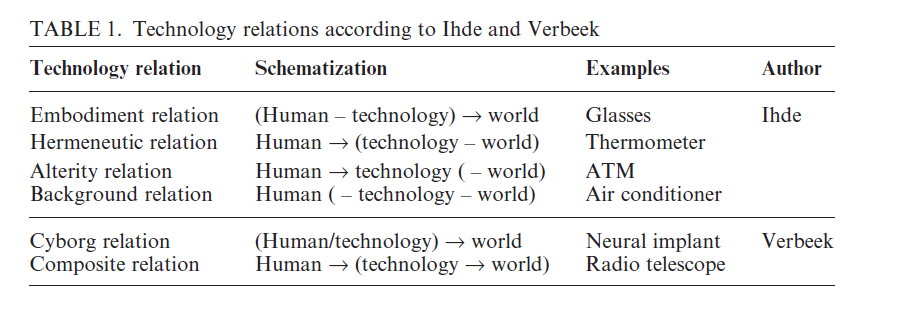
@mediation Nice schemas of Don @Ihde his human-world relationships mediated by technology (page 219):
- Embodiment: (human-technology) -> world
- E.g. glasses or hearing aid
- Hermeneutic relation: human -> (technology-world)
- E.g. thermometer or sonogram
- Alterity relation: human -> technology (world)
- E.g. repairing a car or using a copying machine
- Background relation: human (technology/world)
- Technology impacts the world without being experienced itself
- E.g. airconditioning that automatically turns on or off.
Compare Soraker-Virtual_Worlds_Challenge_Philosophy.md , p. 502
For an overview, see technological_relations_schemas.md
Ihde's approach in opposition to the philosophies that talk about the alienating effects of technology in general.
Ihde’s approach made it possible to investigate how specific technologies mediate human actions, experiences, and interpretations. Against the gloomy theories of alienation that have been fashionable for a long time, it now becomes possible to investigate in more detail how technologies actually help to shape new relations between humans and world. (219)
A pattern in these relations is there is a gradual move "from an extension of our senses to a context for our experiences." (219)
The aforementioned smart technologies fit in this trend and push even further: whereas in the background relation the technology is part of the background, smart technologies merge with the physical environment and become interactive.
A new relation at the far end of the "experience context" can thus be called immersion:
- Immersion relation: human <-> technology/world
- E.g. ambient intelligence
But on the other end of the spectrum, things like smart glasses move beyond just beyond embodied and mediating perception, by adding a "second layer to our world" (219). What is added is not just the mediation of the sensory relation through the glasses (i.e. the embodiment relation), things like Google glasses "also offers a representation of the world" (219).
- Augmentation relation: two parallel circuits
- First of all embodiment: (human-technology) -> world
- And hermeneutic relation: human -> (technology-world)
The major implication of the latter is what Verbeek calls the "bifurcation" of human intentionality (220, but the relevant sentence starts at 219).
Human intentionality is divided over these two parallel tracks of embodiment and the hermeneutic relation (but Verbeek does not name them, I assume these relations are the same when there schema is the same).
This is actually quite interesting in terms of hermeneutics. In the augmentation track there is clearly the need to also interpret what you see in this second augmented layer of reality, in order to make sense of it in the context of the physical reality that it augments.
On the other side of the spectrum, the immersion rather seems to hide this need for interpretation, as we arguably do not even notice anymore that technologies are influencing us so much. I could argue that there is a task for hermeneutics here: as these technologies nudge us they shape our understanding of the surrounding world. This is are perhaps a threat to human autonomy in the sense of the Enlightenment ideal to "dare to think for yourself". What is it to think for yourself when you are being manipulated in your behaviors and perhaps even thoughts?
In other words, the question I could ask here is: is the immersion relation stil a relation of technological mediation or instead rather a one-sided relation of manipulation? Does the general theory of alienation and spooky stories of technologie not re-enter the stage here?
Compare a handy visual representation of all relations as produced by Soraker 2012 (UPDATE: this does actually not map directly onto this more recent story of immersion)
3 Onlife Mediations
What is the impact of these new relations on "societal relations and human existence" (220)?
Examples of social changes due to intelligent technologies.
Ambient technology:
Smart environments with ‘ambient intelligence’ are changing the character of the spaces in which our lives take shape. When public spaces are equipped with smart cameras that can detect suspicious behavior, new norms will be installed. When the doors in geriatric hospitals will have RFID chip readers, they can automatically determine who should be allowed to go out and who does not. When toilets will have sensors that can detect specific substances in our urine and feces, new norms regarding health and illness, and new regimes for healthcare will emerge. (220)
Influence on decision-making:
Moreover, these ‘intelligent’ technologies can also interact with our decisionmaking processes. Under the name of ‘persuasive technologies’, products and systems are being developed to persuade people to behave in specific ways. School toilets can detect if children have washed their hands when they leave, and urge them to do so when they forget. Smart mirrors in the waiting room of medical doctors can recognize one’s face, and morph it into an image of what you will look like in 10 years if you don’t give up smoking, or eating too much, or working too hard. Smart windows in shops can determine the direction of one’s gaze and give extra lighting to articles that seem to interest specific people. (220)
Augmention:
In the configuration of augmentation, technologies like Google Glass have the potential to radically change the character of social interactions. The mere look at somebody else can be enough for a face recognition system to look this person up on the Internet. This would result in a drastic reconfiguration of the boundaries between the public and the private. All one’s private activities that are on the Internet will be much more easily accessible. And all resulting information will be available in social interaction in a asymmetrical way, because people cannot see if the person they meet is simultaneously checking them on the Internet. (220)
Double-presence in the world:
the permanent availability of email, messaging services and Internet information will give us an increasing ‘double presence’ in the world.
In terms of Heidegger:
Our being-in-the-world, as Heidegger called it, is developing into a being-in-multiple-worlds. (221)
These new mediations challenge old frameworks, particularly that of the @Enlightenment :
At the same time it is often hard to see these mediations, because information technologies increasingly challenge the frameworks by which we have come to understand ourselves and the world we live in. Ever since the Enlightenment, we have understood ourselves as relatively autonomous subjects in a world of objects that we can investigate, manipulate, and appreciate. But the self-evidence of this metaphysical framework—in which subjects have intentions and freedom, while objects are passive and mute—is rapidly fading away, now that information and communication technologies have started to challenge it seriously. (221)
Very interesting remark on how or sociality has become intertwined with materiality:
On the one hand, the advent of ‘social media’ has urged us to acknowledge how deeply intertwined our sociality has become with materiality. When Marshall McLuhan claimed that ‘the medium is the message’ (McLuhan 1994/1964), it was hardly possible to foresee that the mediating power of new media would become so strong that a few decades later people would start to wonder if Google is “making us stupid” (Carr 2008) and if virtual sociality is making us be “alone together” (Turkle 2011).
Stiegler also refers to @Carr in his discussion of stupidity, I think.
Onlife Governance
Argument against ethics that depart from the idea that there is a struggle between human and technology:
When human beings cannot be understood in isolation from technology, and vice versa, approaching their relation in terms of struggle and threat, therefore, is like giving a moral evaluation of gravity, or language. It does not make much sense to be ‘against’ them, because they form the basis of our existence. Technologies have always helped to shape what it means to be human. Rather than opposing them, and putting all our efforts in resistance and protest, we should develop a productive interaction with them.
This is interesting. This fits quite well with Stiegler's idea of technology as a supplement for human capacities and its importance for shaping human life. Verbeek seems to immediately bring in an Enlightenment value again: but how can one remain critical when technology is everywhere and is nudging us?
But how can such an interaction still be critical, when the boundaries between humans and technologies disappear? If human practices and experiences are always technologically mediated, there does not seem to be an ‘outside’ position anymore with respect to technology. And if there is no outside anymore, from where could we criticize technology?
Verbeek's own answer:
a hybrid understanding of humans and technologies does not imply that all roles of technology in human existence are equally desirable, and that human beings should redefine themselves as powerless victims of the power of technology. It does imply, though, that the ‘opposition model’ of humanity and technology might not be the most productive model if one wants to change undesirable configurations of humans and technologies. (222)
Verbeek, as becomes clear from all his writing, wants to do a type of ethics that does not just asses technology but accompanies its development.
Verbeek explores @Foucault his notion as critique. What is a fruitful understanding of "critique" that does not commit to some incompatible Enlightenment assumptions?
In his lecture ‘What is Enlightenment?’ (Foucault 1997), Foucault develops an alternative account of the phenomenon of ‘critique’. Foucault is looking for an answer to what he calls ‘the blackmail of the Enlightenment’. This blackmail consists in the pressure that is exerted upon those who want to criticize the Enlightenment, because all their attempts are typically explained as being ‘against’ the Enlightenment. Anyone who dares to do open this discussion immediately raises the suspicion of being against rationality, democracy, and scientific inquiry. Foucault, however, explores if an alternative understanding of Enlightenment would be possible. (222)
Great summary, that is very useful in understanding Gert-Jan's paper on technology and maturity:
Foucault’s answer, however trivial it may seem, is to reinterpret Enlightenment as an attitude, rather than the beginning of a new era. For Kant, as Foucault explains, Enlightenment was primarily a way out of “immaturity”: using “reason” rather than accepting “someone else’s authority to lead us in areas where the use of reason is called for” (Foucault 1997, p. 305). This requires critique: only critique can tell us under which conditions “the use of reason is legitimate in order to determine what can be known, what must be done, and what may be hoped” (Foucault 1997a, p. 308). But for Foucault, critique must not be understood as an attempt to transcend the world—as Kant did—but as an attitude of always looking for the limits of what seems to be given and self-evident.
When you rephrase "looking at the limits of what seems to be given and self-evident" as "questioning the prejudices of your own understanding" this critique gains a hermeneutic flavor. Such a critique does not come from the outside. In other words, c
Foucault, in short, reinterprets critique—the ‘enlightened’ activity par excellence— as a form of practical self-inquiry. Critique means: investigating what has made us the beings that we are, what conditions our existence and what has shaped our current way of living. And, most importantly, it does not require an ‘outside’ position, but can only happing on the basis of positioning ourselves ‘at the limit’. The human subject, after all, is always situated within the world to which it has a relation, and therefore critique can never come from outside. We can never step out of the networks of relations that help to shape our existence, to phrase it in a Latourian way, but this does not imply that we have to give up on critical reflection and self-reflection. (223)
Cf. Heidegger: think the mediality of the medium itself:
Standing at the borders, recognizing the technologically mediated character of our existence, our interpretations and judgments, our practices and preferences, we can investigate the nature and the quality of these mediations: where do they come from, what do they do, could they be different? (223)
Within hermeneutics, a similar form of critique concerned 1) history/tradition as the medium of understanding 2) without understanding/interpretation standing "outside" history. Cf. Heidegger on language in its capacity to disclose being: think the medium itself in its mediality.
Verbeek's form of critique:
but rather its accompaniment ‘from within’, using a concept from the Belgian philosopher Gilbert Hottois (Hottois 1996) and the recent work of Paul Rabinow (Rabinow 2011). The crucial question in such a form of ‘ethical technology accompaniment’ is not how we could impose ‘limits’ to technological developments, but rather how we can deal in responsible ways with the ongoing intertwinement of humans and technologies. (223)
Verbeek's ethics as a form of governing rather than steering or protecting:
It replaces the modernist ambition to ‘steer’ technology and to ‘protect’ humanity against technological invasions with a more modest ambition to ’govern’ technological developments by engaging actively with their social and existential implications. (224)
Onlife Citizenship
- Individuals must anticipate mediations in order to appropriate them and shape mediations in a way that works for them. Verbeek calls this an "ascetic practice" (224).
- Designing technology is no longer morally neutral, as you now design for mediations.
- In this sense policy concerning implementation concerns governing a technologically mediated world.
Bottom line / conclusion:
The real information revolution has yet to begin. The boundaries between human beings and information technologies are blurring ever more rapidly. This requires a normative framework that gives up the idea that we need to control technologies from outside, on the basis of a set of pre-given criteria. Rather, we need to develop ever better ways to understand how information technologies affect us, and to get explicitly get involved in that process, by critically designing, embedding and using information technologies from the perspective of their mediating powers in human existence and our technological society.
Interesting references:
- Carr, N. 2008. Is google making us stupid? The Atlantic, 1 July.
- Foucault, M. 1997. What is enlightenment? In Ethics: Subjectivity and truth, ed. Paul Rabinow. New York: New Press.
- Turkle, S. 2011. Alone together: Why we expect more from technology and less from each other. New York: Basic Books.